

Short answer
Harvia’s North American heater manuals say a heater fence is necessary for safety: build it from 1×2 or 2×2 softwood to match the room, attach it to the wall, and keep it no higher than the top of the heater below the rock line. Model-specific wooden safety railings (for example Harvia HPC3 on Cilindro heaters) bolt to the heater with stainless mounts. Keep every clearance from your heater manual — a guard never shrinks those distances.
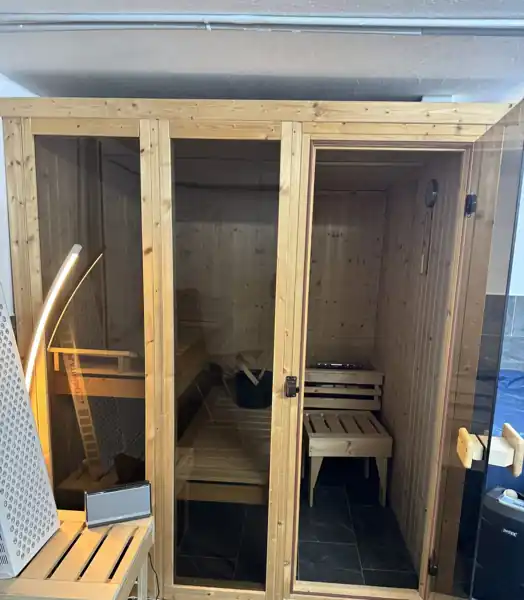
A sauna heater is the hottest object in the room. Bathers stand up, step past it with wet feet and sometimes reach for a ladle while dizzy from heat. A wooden heater guard — also called a heater fence or safety railing — is the soft barrier that keeps skin and towels off the shell. This guide explains what Harvia and common building-code language require, how clearances work with a fence, which product types fit which heaters, and what to check before you buy. For door swing next to the heater, see our sauna door guide. For air inlets near the heater, see sauna ventilation.
Why a sauna heater guard matters
A traditional electric sauna heater runs hot enough to burn skin on contact. The metal shell, the rock cage and any exposed elements stay far above bath temperatures even when the air feels “comfortable” on the upper bench. Harvia’s English-language product story on safety railings puts the purpose plainly: a wooden railing installed around the heater is there simply to stop a bather from touching the heater. That is burn prevention, not decoration first.
The same idea shows up in building-code language used in many U.S. jurisdictions. The International Residential Code section on sauna heaters (commonly published as M1902) requires sauna heaters to be protected from accidental contact by a guard of material with low thermal conductivity, such as wood, and says the guard must not have a substantial effect on heat transfer into the room. Local amendments vary — New York City’s mechanical code, for example, uses nearly the same “approved guard or barrier” wording — so treat the code cite as a reason to ask your inspector, not as a DIY permit. Always install the heater to the manufacturer’s instructions and follow UL 875 where that standard applies.
Harvia goes further than a soft recommendation in its KIP-series owner’s and installation manual for the North American market. Under accessories it states that a heater fence is necessary for safety and should be constructed of 1″ × 2″ (25 × 50 mm) or 2″ × 2″ (25 × 50 mm) softwood to match the sauna interior. The fence should attach to the wall and should not be placed higher than the top of the heater below the rock line. A separate construction checklist line for a heater guardrail simply says to use matching softwood. In other words, the maker expects a physical softwood barrier, sized and placed against the published clearance figures — not a towel rack, not a metal cage that becomes another burn surface, and not a fence that rises into the stone field.
Harvia’s consumer article on safety railings adds the practical why: anyone can lose balance standing up from the bench; families with children and older bathers benefit most; some building supervisors even require a railing for final inspection. Design and safety are not opposites — alder, aspen and heat-treated aspen are listed as woods that do not heat up as aggressively as denser species, which is why those woods show up in factory railings. None of that replaces the heater-specific safety distances printed in your manual. The guard is the last line that keeps a hand, hip or towel off hot metal when someone steps wrong.
Clearances: the fence never shrinks the manual
Clearances are fire and burn rules. The heater fence sits outside those numbers; it does not invent new ones. Harvia Virta-family manuals (for example the HL8U1SA operator’s manual) show minimum clearances from walls and from a wood fence in the same ventilation figures that place the air inlet near the heater. Typical drawings mark about 2″ (50 mm) from fence parts in several directions, with other wall clearances called out in inches for each model. Exact millimetres change by heater — read the figure for your model before you cut lumber or order a rail.
For wall-mounted or corner heaters, Harvia’s KIP guidance is to attach the fence to the wall so it stays put when someone leans on it. Do not float a flimsy freestanding frame that can tip into the heater. Height is capped: the fence must not rise higher than the top of the heater below the rock line, so bathers are blocked from the hot shell without creating a shelf over the stones where towels or a ladle could land. Leave the rock field open for pouring water and for airflow through the heater.
When the heater maker sells a model-specific safety railing (Harvia Cilindro HPC3/HPC4, Virta HL3S, Spirit HSP3M and similar), follow that accessory’s install sheet. Those rails usually clamp or bolt to the heater with stainless brackets at a fixed height. They are designed so the wood stays touchable while the metal mounts take the heat path. Do not drill randomly into a heater shell; use the holes and hardware the accessory kit provides. If you build a softwood fence yourself, keep air gaps honest: a solid boarded box around the heater can trap heat against walls and starve the heater of intake air. Open rails or spaced 1×2 / 2×2 stock match what Harvia describes.
Mind the rest of the room while you place the guard. The door must still open out freely — our sauna door guide covers swing and locks. Floor mats and duckboards belong outside the heater safety zone; our floor-mat guide warns against covering clearances. Supply vents often sit low near the heater; do not let a fence panel block the inlet described in the ventilation guide. After install, walk the path from bench to door with the heater cold: hips, hands and a dangling towel should hit wood before metal.
Floor comfort layers stop short of the heater zone — see sauna floor mat and duckboard. For the wall stack behind the heater, see what saunas are made of.
DIY fence, factory railing or cedar guard?
Three product patterns cover most home saunas.
First, a DIY softwood heater fence: 1×2 or 2×2 kiln-dried softwood (cedar, aspen, alder, spruce — matching your panelling) framed to the wall with stainless or hot-room-rated fasteners. This matches Harvia’s KIP wording and suits wall heaters where you control the carpentry. Build open rails, keep the top below the rock line, and verify every gap against the heater’s clearance chart before the first heat-up.
Second, a factory safety railing made for one heater family. Harvia’s Cilindro rails (HPC3 for many 6–9 kW Cilindro units, HPC4 for larger Cilindro) use heat-treated aspen arches on stainless mounts that fasten to the heater. Virta heaters have the HL3S three-sided wood railing; Spirit heaters use HSP3M. HUUM and other brands sell matching arcs for their tower heaters. These cost more than a simple cedar corner guard, but they fit the cylinder geometry and keep wood off the stone cage by design. Buy only the SKU listed for your exact heater model.
Third, a freestanding or two-/three-sided cedar heater guard sold as a generic accessory. These are rectangular softwood frames sized for common wall or corner heaters (for example a two-sided cedar guard around 24″ wide × 15″ deep × 14″ high with a slightly smaller interior opening). They help when you want a ready-made burn barrier without a model-specific kit. Measure your heater footprint and the free floor outside the manual clearances before you order: the interior opening must clear the heater shell with the same gaps the manual requires to walls and combustibles. A guard that forces the heater closer to a wall is the wrong size.
Skip metal mesh “cages” that become a second hot surface, plastic that is not rated for sauna temperatures, and any finish that Harvia warns against in the hot room (ordinary varnish or stain that can off-gas). Untreated or sauna-appropriate softwood is the pattern across manuals and code language. Infrared cabin heaters are a different product: follow the cabin maker; this guide targets traditional hot-rock electric heaters where bathers walk past a glowing stone cage.
| Type | Best for | Watch-outs |
|---|---|---|
| DIY softwood fence (1×2 / 2×2) | Wall or corner heaters; match existing panelling | Must keep manual clearances; attach to wall; top below rock line |
| Model-specific safety railing (HPC3, HL3S, HSP3M…) | Cilindro, Virta, Spirit and other kits with official SKUs | Buy only the SKU for your exact model; use kit hardware |
| Generic 2- or 3-sided cedar guard | Common rectangular heaters when no official rail exists | Measure interior opening vs heater + clearances before ordering |
What to look for when you buy
- Your heater model and clearance figure. Print or save the page that shows wall and fence distances.
- Softwood that stays touchable. Cedar, aspen, alder or heat-treated aspen — not a metal cage.
- Height below the rock line. Block the shell, leave the stones open.
- Secure mounting. Wall-attached DIY fence or stainless kit mounts — nothing that tips into the heater.
- Airflow and vents left open. Do not box the heater or cover the low supply vent.
Buy in this order: confirm your heater model and open the clearance page in its manual; measure the free space on the open sides; decide DIY fence, model-specific railing or a sized cedar guard; then check wood species, mounting method and height. Prefer softwood that matches the benches so the rail does not become the hottest touch point. Prefer stainless hardware. Prefer a design that leaves airflow and ladle access to the stones.
On November 6, 2026, two Amazon listings that name sauna heater guard or safety railing use were in stock: a two-sided cedar heater guard from The Sauna Place / SAWO at $95.99 (ASIN B0FLY5YT1W; exterior about 24 × 15 × 14 in, interior about 22⅓ × 14⅛ × 14 in), and the Finlandia / Harvia HPC3 heat-treated aspen safety railing for Cilindro 6, 7 and 9 kW heaters at $287.38 with limited stock (ASIN B0B9T6BM3P). Dealer-only SKUs such as Harvia HL3S for Virta heaters (listed around $330 at specialty shops) are worth comparing when your heater is a Virta, not a Cilindro. We have not installed these products ourselves; sizes and prices come from the live listings and manufacturer pages. Recheck fit against your manual before you buy.
If your heater is a tower or mesh-cage design (Cilindro, HUUM HIVE/CLIFF and similar), start with the official railing SKU before you look at generic cedar frames. Those shells are round or polygonal; a rectangular two-sided guard may leave hot sides open or sit inside a required clearance. For a flat-front wall heater with published fence clearances, a wall-attached softwood fence or a measured two-/three-sided cedar guard is usually enough. Compare interior width and depth to the heater body plus the millimetres shown to the wood fence in your manual — if the listing is smaller than that envelope, skip it.
Price alone is a weak filter. A $90 cedar guard that forces the heater 2 in closer to a combustible wall is the wrong buy; a $280 model-specific rail that keeps the published envelope is the right one. Dealer pages (for example Harvia HL3S for Virta at specialty shops) often beat Amazon on exact fit even when Amazon wins on shipping speed for generic cedar. Keep receipts and the manual page with clearances in the same folder as your electrical rough-in notes so a future inspector or electrician sees why the rail sits where it does.
As an Amazon Associate we earn from qualifying purchases.
Two heater guards that match the types above:
Cedar two-sided guard for common wall or corner heaters. Exterior about 24 × 15 × 14 in; interior about 22⅓ × 14⅛ × 14 in. Confirm the opening still leaves your heater’s manual clearances.
Check price on AmazonHeat-treated aspen arches with stainless mounts made for Harvia Cilindro 6–9 kW heaters. Not a universal fence — only for matching Cilindro models.
Check price on AmazonAs an Amazon Associate we earn from qualifying purchases.
If your heater stands free of the wall or is a larger Cilindro:
Three-sided cedar frame for heaters that are open on three sides, such as a unit on a flat wall away from the corner. Measure the interior opening against your heater body plus the manual’s fence clearances before you order.
Check price on AmazonThe larger Cilindro railing, listed for the 11 kW model. Same idea as the HPC3: wooden arches on stainless mounts that fasten to the heater. Only for the Cilindro model it is listed for — check your heater’s model number first.
Check price on AmazonFrequently asked questions
Do I need a sauna heater guard?
For traditional electric heaters, yes in practice: Harvia’s KIP manual says a heater fence is necessary for safety, and many building codes require a low-conductivity guard such as wood. Follow your heater manual and local inspector.
How high should a sauna heater fence be?
Harvia says the fence should not be placed higher than the top of the heater below the rock line. That blocks contact with the hot shell without creating a shelf over the stones.
What wood is best for a heater guard?
Matching softwood — cedar, aspen, alder or similar kiln-dried sauna woods. Harvia highlights alder, aspen and heat-treated aspen because they do not heat up as aggressively. Avoid finishes that can release vapors when hot.
Can a heater guard replace safety clearances?
No. Clearances to walls, benches and combustibles come from the heater manual and must stay intact. The guard sits outside those distances; squeezing the heater into a smaller pocket to fit a rail is unsafe.
Are model-specific railings better than a DIY fence?
They are better when your heater has an official kit (Cilindro HPC3/HPC4, Virta HL3S, Spirit HSP3M and similar), because mounts and height are designed for that shell. A careful DIY 1×2/2×2 softwood fence still matches Harvia’s general KIP instruction for wall-attached fences.
Sources
- Harvia. KIP sauna heater owner’s and installation manual (heater fence necessary for safety; 1×2 or 2×2 softwood; attach to wall; not higher than top of heater below rock line; heater guardrail of matching softwood)
- Harvia. HL8U1SA owner’s/operator’s manual (heater fence section; clearances from wall and wood fence in ventilation figures)
- Harvia. Safe steam, thanks to the safety railing (purpose of wooden railing; alder/aspen/heat-treated aspen; families and seniors; inspection note)
- Harvia. Cilindro safety railing product family (heat-treated birch/aspen arches, stainless mounts; HPC example)
- UpCodes. IRC M1902 Sauna Heaters (guard of low thermal conductivity such as wood; install per manufacturer; UL 875)
- The Sauna Place. Harvia HL3S safety railing for Virta HL6/HL8/HL9 (dealer example, dimensions)
- Amazon listing B0FLY5YT1W — 2-sided cedar sauna heater guard (product dimensions and stock checked 06.11.2026)
- Amazon listing B0B9T6BM3P — Finlandia/Harvia HPC3 railing for Cilindro 6/7/9 kW (price/stock checked 06.11.2026)
Editorial note: this guide is general information, not building, electrical or code advice. We have not installed these guards ourselves; the guidance follows the sources above and manufacturer instructions. Follow your heater manual and local codes. Checked on November 6, 2026.