

Short answer
A sauna door must open outward and must not lock: heater manuals from Harvia and Scandia say so. Instead, the door is held shut by a magnetic or roller catch that opens with a push. Most ready-made sauna doors use 8 mm tempered safety glass in a sealed timber frame, in openings such as 700 × 1,900 mm. Glass loses heat, so Harvia counts each square metre of it as an extra 1.2 m³ when sizing the heater.
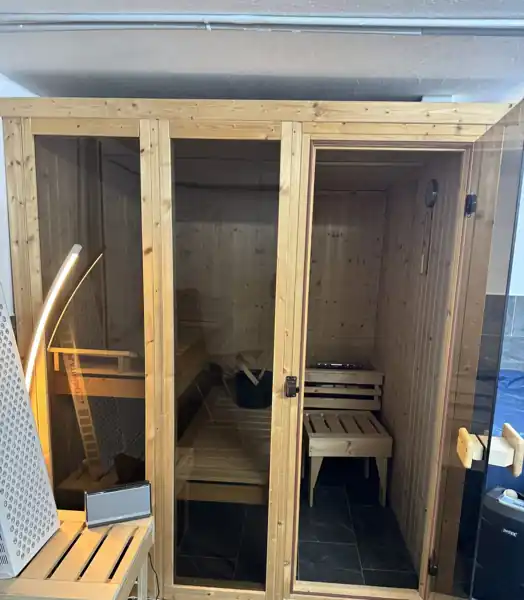
The door is the part of a sauna you touch every time, and the part most often chosen last. That is a mistake, because the door decides how safely people can get out, how much heat escapes, how big the heater has to be and how the room is ventilated. This guide covers the safety rules heater makers set for sauna doors, the choice between glass and wood, standard sizes and the gap under the door, and what to check before you buy one. For windows in the sauna walls, see our separate guide to sauna windows.
Sauna door rules: opens outward, never locks
Heater manufacturers agree on the basic rule. Harvia’s installation manual for its KIP heaters says the door “must open out and should not have a lock”. The Scandia heater installation guide says the sauna door must always open outward and can never include a lock. The reason is simple: someone who feels faint or unwell in the heat has to be able to leave by pushing the door, without looking for a key or a latch. A door that swings outward also cannot be blocked by a person who has slumped against it on the inside.
How the door stays closed
Instead of a lock, sauna doors are held by a catch that gives way when you push. The Australian sauna builder BSC Wellness lists the options found in Harvia’s instructions: magnetic catches, friction catches, and spring- or gravity-loaded closers. Depending on the model, Harvia’s glass doors close with a roller latch or a magnetic catch. Harvia’s installation instructions for its glass doors even end with the step “loosen the roller latch to prevent the door from locking itself when the door is closed the first time”. If you replace an old interior door with a sauna door, do not reuse a lockable handle set.
Handles on both sides
A sauna door needs a handle you can pull from outside and push or pull from inside. BSC Wellness notes that sauna door handles are usually wooden, because wood stays more comfortable to hold in a hot room than metal, which conducts heat. Harvia offers a long vertical wooden handle in aspen or alder as an alternative to the chrome knob on its glass doors; the PROSAUNAS door below pairs a stainless steel pull outside with a wooden handle inside.
As an Amazon Associate we earn from qualifying purchases.
A handle set with wood inside and steel outside:
A two-piece handle set from Sentiotec, a sauna brand of the Harvia group: a stainless steel pull for the cool side of the door and a wooden handle for the hot side, so the part you grip inside stays comfortable. The maker lists 300 mm length, 200 mm hole spacing and 10 mm holes, with mounting hardware included. Check that the spacing matches the holes in your door before you order.
Check price on AmazonSigns and checks
Harvia’s KIP manual asks for the metal “WARNING” sign supplied with the heater to be fixed outside, on the sauna door. When a sauna heats slowly, the same manual lists heat loss around or under the door as one of the first things to check. A door that rubs, sticks or swells is a safety problem as well as a comfort one, because it has to open easily from the inside every time. Check that it still swings freely after the first few heat cycles.
Glass door or wooden door?
A glass door makes a small sauna feel bigger, lets light in and lets you see who is inside, which matters with children or in a shared home. A solid wooden door is the traditional choice: it gives full privacy, keeps more heat in and does not need cleaning like glass. Both work if they are made for a sauna. The differences are mainly heat, privacy and upkeep.
| Wooden door | Glass door | |
|---|---|---|
| Look | Traditional, closed, cosy | Open and light; the room is on show |
| Privacy | Complete | Clear, grey, bronze or satin (frosted) glass |
| Heat loss | Lowest | Higher; counts as uninsulated surface |
| Heater sizing | No extra allowance | Harvia: +1.2 m³ per m² of glass |
| Supervision | Not without a vision panel | Easy to see in |
| Cleaning | Wood care only | Glass marks and fingerprints show |
| Outside surface | Stays cool | Glass warms up |
What glass does to the heater
Glass has no insulation, so it keeps drawing heat out of the room while the sauna runs. Harvia’s support page on choosing heater power says that one square metre of stone, glass or similar non-insulated surface raises the power requirement as much as an extra 1.2 m³ of room volume. BSC Wellness puts the glass in a typical 0.7 × 1.9 m door at about 1.3 m², which adds about 1.6 m³, and cites Harvia’s example of a 10 m³ room with a glass door that needs about the output of a 12 m³ room. Decide on the door before you choose the heater. Our sauna heater size calculator lets you add the glass area.
Safety glass
Purpose-made sauna doors use tempered (toughened) safety glass; Harvia’s glass doors use 8 mm tempered glass, and the PROSAUNAS doors sold in the US use the same thickness. Tempered glass is much stronger than ordinary glass and breaks into small granules instead of sharp shards. In the US, the International Residential Code treats glazing in doors as a hazardous location (R308.4.1), and also glazing in walls containing or next to saunas and steam rooms when its bottom edge is less than 60 inches above the floor (R308.4.5), so safety glazing is required there. Never put ordinary glass in a sauna door. Harvia warns that a tempered door can still shatter from a sharp knock, for example against the floor during installation.
Privacy without a wooden door
If the sauna opens off a bedroom or bathroom, satin glass lets light through but blocks the view. Harvia recommends its satin glass door as a connecting door for exactly that reason. Grey and bronze tints soften the view and reduce glare without blocking it.
Sauna door sizes, fitting and the gap under the door
Sauna doors are usually narrower and lower than house doors, which keeps heat in. European doors are named by width and height in decimetres: a 7×19 door fits a 700 × 1,900 mm wall opening. Harvia’s standard glass doors, as listed by BSC Wellness from Harvia’s data sheets:
| Harvia door | Frame outside (W × H) | Clear opening through the frame | Minimum wall opening width |
|---|---|---|---|
| 7×19 | 690 × 1,890 mm | 606 × 1,846 mm | 700 mm |
| 8×19 | 790 × 1,890 mm | 706 × 1,846 mm | 800 mm |
| 9×19 | 890 × 1,890 mm | 806 × 1,846 mm | 900 mm |
| 8×21 | 790 × 2,090 mm | 706 × 2,046 mm | 800 mm |
| 9×21 | 890 × 2,090 mm | 806 × 2,046 mm | 900 mm |
Harvia’s timber frames are 92 mm deep, and a 7×19 pine-frame glass door weighs 31 kg, so the wall around it needs solid framing. US doors are sold in inches; the PROSAUNAS 24 × 73 door, for example, has a frame of 27 × 75 inches. Always frame the opening from the data sheet of the door you have actually bought, not from a generic size.
Swing and handing
Because the door opens outward, you need free floor outside for it to swing, about 650 to 850 mm for the Harvia sizes above. Choose left or right hanging so the door does not open into a walkway, against a shower screen or into a towel hook. Harvia’s glass doors can be rehung from left to right; its Formula manual describes how.
The gap under the door
The gap under a sauna door is part of the ventilation, and manufacturers give different figures for different set-ups:
- Scandia: when the door is undercut, small rooms need no other venting; leave 3/4 to 1 inch (19 to 25 mm) between the finished floor and the door.
- Harvia, installation manual for its Formula sauna cabins: a gap of at most 25 mm under the glass door.
- Harvia heater manuals (for example KIP): if the exhaust air vent is in the washroom, the gap under the door must be at least 100 mm, and mechanical exhaust ventilation is mandatory.
- BSC Wellness reports that Harvia’s 2022 glass door instructions recommend 100 to 200 mm under a sauna door.
So there is no single right number. Follow the ventilation plan in your heater manual and the instructions that come with the door, and settle the gap before you frame the opening, because it changes the opening height. Our guide to sauna ventilation explains how the gap fits with the vents.
What to check before you buy a sauna door
- Made for saunas. Tempered safety glass (8 mm is standard) or a solid sauna-grade wooden door, a door seal and hinges that cope with heat and moisture. Harvia uses stainless steel hinges.
- No lock. A magnetic, roller or friction catch only, and handles on both sides.
- Opens outward, with the hanging side that suits your room and space outside for the swing.
- Size from the data sheet. Frame size, wall opening, frame depth to match your wall, and the gap under the door.
- Glass and heater together. Add the glass area to the heater calculation.
- Privacy. Clear, tinted or satin glass, depending on what is on the other side.
- Care. Harvia’s KIP manual advises sealing the wood around the glass, inside and outside, with sauna sealer to prevent warping. After each session, leave the door open to let the sauna dry; see how to prevent mold in a sauna.
Prices vary widely. On November 3, 2026, the PROSAUNAS prehung 24 × 73 glass door below cost $1,288 on Amazon, and a cedar door handle about $27. Replacing only the handle or catch is a cheap fix for an old door; a new door may need the opening reframed if its size differs. We have not tested these products ourselves; the details come from the manufacturer and the Amazon listings.
As an Amazon Associate we earn from qualifying purchases.
A complete door on its own frame: 8 mm tempered safety glass, an aspen frame of 27 x 75 x 3-5/8 in, three hinges, and a ladder pull outside with a wooden handle inside. This listing is left-hanging; check the handing, the rough opening and the catch with the seller before you frame the wall.
Check price on AmazonA solid cedar pull for the inside or outside of a wooden or framed sauna door, with 8 15/16 in between the holes. Wood stays more comfortable to hold than metal in a hot room. Fasteners are chosen by the installer, so measure your door thickness first.
Check price on AmazonFrequently asked questions
Which way should a sauna door open?
Outward, out of the hot room. Harvia’s and Scandia’s heater manuals both say the sauna door must open out, so that anyone inside can leave by pushing the door, even if they feel faint.
Can a sauna door have a lock?
No. Heater makers say a sauna door should not have a lock. It is held closed by a magnetic, roller or friction catch, or a spring or gravity closer, that opens with a push. Harvia even asks installers to loosen the roller latch so a new door cannot lock itself.
Is a glass or wooden sauna door better?
Neither is better for every room. A glass door adds light and lets you see inside, but it loses more heat; Harvia counts each square metre of glass as an extra 1.2 m³ when sizing the heater. A wooden door keeps more heat in and gives full privacy.
What size is a standard sauna door?
In Europe, common sizes are 7×19, 8×19, 9×19, 8×21 and 9×21, meaning wall openings of 700 to 900 mm wide and 1,900 or 2,100 mm high. Harvia’s 7×19 door has a frame of 690 × 1,890 mm. US doors are sold in inches, such as 24 × 73. Always use the data sheet of your door.
How big should the gap under a sauna door be?
It depends on the ventilation design. Scandia gives 3/4 to 1 inch for an undercut door, Harvia’s Formula cabin manual a maximum of 25 mm, and Harvia’s heater manuals at least 100 mm if the exhaust vent is in the washroom. Follow your heater manual.
Sources
- Harvia. KIP sauna heater owner’s and installation manual (door must open out, no lock; warning sign on the door; gap under the door at least 100 mm with washroom exhaust; seal wood around door glass)
- Scandia. Electric heater installation guide (door always opens outward, never a lock; 3/4 to 1 inch under an undercut door)
- Harvia. Formula sauna installation manual (glass door installation, minimum opening widths, max. 25 mm under the door, loosen the roller latch)
- Harvia Support. How do I select the correct heater power? (1 m² of glass counts as 1.2 m³)
- Harvia. Glass door clear 7×19 pine frame (seal, glass colours, handles, 690 × 1,890 × 92 mm, 31 kg)
- BSC Wellness. Sauna glass and doors: design, safety and heat (reviewed October 2026; Harvia door sizes, catches, gap under the door)
- Boulder County. B30 Safety glazing (2021 IRC R308.4.1 and R308.4.5)
- PROSAUNAS prehung glass sauna door 24×73 (product information: 8 mm tempered glass, frame 27 x 75 x 3-5/8 in)
- The Sauna Place curved cedar sauna door handle (product information: 10.5 in, 8 15/16 in hole spacing)
Editorial note: this guide is general information, not building or electrical advice. We have not tested sauna doors ourselves; the guidance is based on the sources above and on manufacturer instructions. Building codes differ by country, so your local code and the manuals of your heater and door apply. Checked on November 3, 2026.