

Short answer
A barrel sauna makes sense if you want a compact outdoor kit that heats quickly, sheds rain and goes up in a day or two, and you are happy sitting on one low bench. Its main weakness is heat layering: with the bench low and your feet near the floor, your feet sit in much cooler air than your head. If you want two bench levels, standing room and the most even heat, a cabin-style sauna is the better choice.
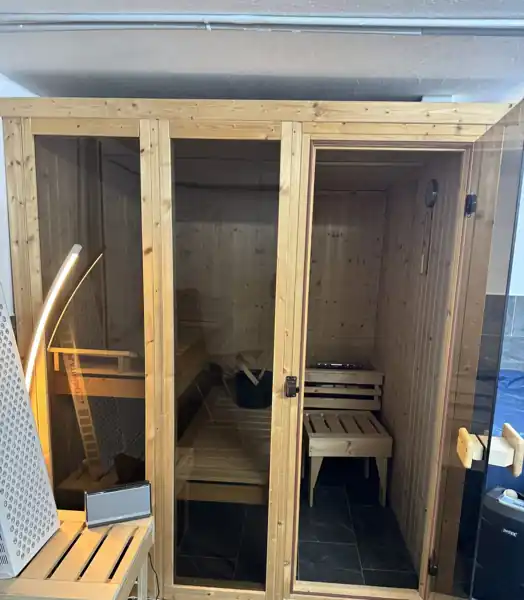
Barrel saunas are everywhere in backyard sauna ads: round, cedar or spruce, held together by steel bands, often with a small porch. They look great and they are one of the simplest ways to get a real wood sauna outside. They also have a loyal group of critics, mostly Finnish-style sauna builders, who say the shape gives a worse sauna experience than a plain box. Both sides have a point. This guide collects what manufacturers, critics and one owner who measured his own barrel have published, so you can decide whether the shape suits the way you want to use a sauna before you buy.
What a barrel sauna does well
A barrel sauna is built from long wooden staves that sit in round end panels and are pulled tight by stainless steel bands. Almost Heaven, a US barrel sauna maker, describes its barrels as jointed staves “fitting tightly together under stainless steel bands and utilizing a minimal amount of fasteners,” so the wood can swell in humid weather and shrink in dry weather without splitting the structure.
The main selling point is heat-up time. Almost Heaven explains it with a simple picture: take a square and shave off the corners. You keep roughly the same usable seating space but have less air to heat, so the room warms up faster than a box of the same width. The company also says the curved walls guide rising heat back down instead of letting it pool under a flat ceiling, and that its thick staves keep the sauna well insulated. Treat these as maker claims; the critics below dispute the even-heat part.
Owners mostly agree on the practical advantages. A barrel arrives as a kit, needs no framing, drywall or separate insulation layer, and can sit on cradles on a firm, level base. The round top has no flat roof, eaves or window sills where water can sit. One owner who writes the Sauna from Japan blog reports that his barrel went up in a day with a crew and that, after three years, weather resilience is one of the things he likes most. He also says barrels were still cheaper than cabins of similar capacity when he compared prices in 2026.
A barrel is also easy to place. It is a self-contained object you can set on gravel, pavers, a slab or a deck, which is why it is a common first outdoor sauna in North America. Our guide to the outdoor sauna foundation explains which bases work. You still need power for an electric heater, or a safe chimney for a wood stove, and you still need to follow the heater manual for clearances and ventilation.
The cold-feet problem: heat layering in a barrel
Every sauna is hotter at the ceiling than at the floor. Finnish sauna practice handles this with height: the upper bench sits high enough that the bather’s feet are at or above the top of the stove. Saunologia, a Finnish sauna publication, calls this the “law of löyly.” In most barrels the curve leaves room for only one low bench, so your feet rest on the floor, the coolest place in the room.
The best published data comes from a barrel owner, Mika Javanainen, who placed temperature sensors at the ceiling, at bench level and on the floor of his own 6 kW barrel and published the results on Saunologia in 2024. It is one owner’s sauna, not a lab test, but it shows the size of the gap.
| Condition (one barrel, Saunologia 2024) | Top | Bench level | Floor |
|---|---|---|---|
| No fans, start of session | 71.3 °C (160 °F) | 44.4 °C (112 °F) | 26.8 °C (80 °F) |
| No fans, peak after steam | 75.4 °C (168 °F) | 48.4 °C (119 °F) | 27.1 °C (81 °F) |
| Fans at 100 %, start of session | 73.7 °C (165 °F) | 52.6 °C (127 °F) | 29.1 °C (84 °F) |
He describes the standard barrel layout as gravity ventilation: an intake at floor level below the heater and an exhaust high on the opposite wall. In his words, that “creates draft on the floor, further increases heat stratification, and results in energy loss.” After adding a small fan intake about 3 feet above the stove and a fan exhaust under the bench on the opposite side, bench level rose by several degrees. The floor, however, stayed about 20 °C cooler than the bench, so he keeps his feet on the opposite bench and also added a slide-in bench that lets him sit higher.
Critics put the gap more strongly. Trumpkin, a sauna researcher whose notes are published by LocalMile, says bathers should have a head-to-toe difference of no more than 36 °F and reports that barrels range from 60 to 120 °F. Heartwood Saunas, a sauna builder, says there is only room for one bench tier in a barrel and that headroom is “seriously limited.” Our sauna size guide explains the bench-to-ceiling distances that cabin designs use to avoid this.
None of this makes a barrel unusable. Many owners lie down, pull their feet up or simply enjoy it as it is. It does mean that the shape, not just the heater, limits how even the heat can be.
Barrel vs cabin sauna, side by side
A cabin-style sauna here means any sauna with straight walls and a flat or pitched ceiling, from a small cube kit to a framed, insulated outdoor building. The table sums up what the sources say. Where they disagree, both views are listed.
| Factor | Barrel sauna | Cabin sauna |
|---|---|---|
| Heat-up time | Faster, according to makers and owners, because there is less air to heat | Usually slower for the same seating, depends on heater and insulation |
| Evenness of heat | Low bench, feet near the floor; owner data shows a large head-to-floor gap | Upper and lower benches let your whole body sit in the hot zone |
| Bench layout | Usually one bench level; curved walls limit backrests | Two or three tiers, L-shaped benches, proper backrests |
| Headroom | Limited, especially near the side walls | Standing room is easy to plan |
| Walls and insulation | Solid single-wall staves, no separate insulation layer | Solid wood or framed walls with insulation and a vapor barrier |
| Weather | Round top sheds rain and snow; covers and roofs are sold for extra protection | Roof, eaves and trim need normal exterior upkeep |
| Upkeep | Bands may need tightening and filler staves added; stain the outside | Standard exterior maintenance; fewer moving joints |
| Assembly | Kit, often one or two days | Small kits are quick; custom builds take longer |
| Lying down | The curve suits lying on the bench | Depends on bench length |
Maintenance is the part buyers often miss. Almost Heaven’s FAQ says you may need to tighten the bands or add filler staves “after a period of time, usually within the first few months,” because the wood shrinks or swells with moisture, and its manual recommends treating the outside with an exterior stain or sealant because the wood ships untreated. The same manual says heavy rain may seep into the joints between staves without harming the sauna. Critics are less relaxed: Trumpkin’s notes say stave construction tends to develop leaks, mold and rot and that barrels often do not last more than about five years. That claim comes from a critic, not a long-term study, but it is a good reason to plan a roof or cover from the start.
Insulation is the other difference. Barrels rely on thick solid staves, while framed saunas use insulated walls with a foil vapor barrier. Our guide on whether outdoor saunas need insulation covers both. Heartwood Saunas argues that single-wall kits fall short in temperate climates such as the UK and much of Europe, while snow cover can help in colder places.
How to choose, and how to get more out of a barrel
Start with how you plan to use the sauna. If you mostly want a quick, hot session for one or two people, often lie down, and like the look, a barrel is a reasonable buy. If you want several people to sit upright together, prefer the classic Finnish layout with feet above the stones, or want to stand up inside, a cabin suits you better. Space and budget then narrow it down.
If you are leaning toward a barrel, these checks come from the sources above:
- Look for a higher or second bench. SaunaMarketplace, a sauna marketplace site, points to barrel models with an upper bench or a two-level bench layout as a fix for cold feet. Compare inside bench height and depth, not just the outside diameter.
- Size the heater to the room, not the shape. The Sauna from Japan owner says an undersized heater gives the lukewarm barrel critics describe, and that a 2 m barrel usually ships with 4 to 6 kW. Tahoe Sauna Company warns that a much bigger heater mostly heats the ceiling. Follow the heater maker’s room-volume range.
- Plan the ventilation. Saunologia’s test moved the intake above the stove and the exhaust below the bench on the opposite side. Any change must still meet the heater manual. Our article on whether saunas need to be vented explains the common layouts.
- Get your feet off the floor. Put your feet on the opposite bench, use a raised footrest or slatted board, or lie down.
- Protect it from weather. Plan a roof, shelter or cover, stain the outside as the maker recommends, and check the bands in the first months.
- Budget the whole project. Add the base, electrical work, heater, delivery and assembly to the kit price before you compare with a cabin.
Two small add-ons help with the cold-feet issue: a slatted cedar board for your feet, and a thermometer so you can see how hot it really is where you sit. These are product examples from Amazon, not items we have tested.
As an Amazon Associate we earn from qualifying purchases.
Handmade solid Western Red Cedar with a raised slatted design so water drains through. In a barrel it gives your feet a wooden surface instead of the floorboards; lift it out and stand it on edge to dry after wet sessions.
Check price on AmazonA battery-free dial instrument for the sauna wall. The listing gives 0 to 120 °C (30 to 250 °F) at ±2 °C and 0 to 100 % relative humidity at ±5 %. In a barrel, hang it near head height at the bench so you see the temperature you actually sit in, not just the hottest air in the curve.
Check price on AmazonAs an Amazon Associate we earn from qualifying purchases.
If your barrel kit ships without the basics:
A four-piece Western red cedar accessory set sold under the Almost Heaven brand, the US barrel maker quoted in this guide. Check the listing for the exact pieces included and make sure the bucket and ladle are wood or plastic-handled, since bare metal gets hot in a barrel’s small, warm interior. We have not tested this set ourselves.
Check price on AmazonFAQ
Are barrel saunas any good?
They can be, if you know the trade-off. Barrels are compact, heat quickly and handle rain and snow well, and many owners are happy with them. Their weak point is the low bench: your feet sit near the coolest part of the room, so the heat is less even than in a cabin with an upper bench.
Why do my feet get cold in a barrel sauna?
Hot air rises, and in most barrels the bench is low, so your feet rest near the floor. One owner’s measurements published by Saunologia showed the floor about 20 °C (36 °F) cooler than bench level even after adding fans. Putting your feet up on the bench or a raised footrest helps.
Is a barrel sauna cheaper than a cabin sauna?
Often, for the same number of seats, because a barrel uses less material and comes as a kit. Prices change quickly, so compare complete quotes: the kit, heater, base, electrical work, delivery, assembly and a cover if you want one, before you compare.
Do barrel saunas need insulation?
Usually not. Almost Heaven builds its barrels from thick solid wood staves held by stainless steel bands, without a separate insulation layer. Critics such as Heartwood Saunas say single-wall kits fall short on heat efficiency in temperate climates such as the UK, so check the maker’s guidance for your climate.
How long does a barrel sauna last?
It depends on the wood, the climate and the care. Almost Heaven says you may need to tighten the bands or add filler staves in the first few months and recommends staining the outside. Some critics report leaks and short lifespans in barrels that are not maintained, so a roof or cover and regular checks matter.
Sources
- Almost Heaven Saunas. Why choose a barrel sauna? (heat-up, heat distribution, staves and stainless steel bands)
- Almost Heaven Saunas. Frequently asked questions (tightening bands, filler staves, staining the exterior)
- Almost Heaven Saunas. Barrel sauna installation and owner’s manual, 2024 (PDF; filler staves, water seepage, exterior stain)
- Saunologia.fi. Improving a barrel sauna: a case study (Mika Javanainen, 2024; temperature at top, bench and floor, fan ventilation)
- Saunologia.fi. Critical sauna bench dimensions for comfort and better löyly (law of löyly)
- LocalMile. Trumpkin’s notes on barrel saunas (head-to-toe temperature difference, stave construction, lifespan)
- Heartwood Saunas. Comparing hand-built, kit and barrel saunas (single bench tier, headroom, single-wall insulation)
- Sauna from Japan. Barrel vs cabin: an honest comparison from an owner (heat-up, heater size, weather, price)
- SaunaMarketplace. 7 reasons barrel saunas fail (cold feet, upper-bench barrel models)
- Tahoe Sauna Company. Barrel sauna cold feet: why it happens and how to fix it (ventilation layout, heater size)
Editorial note: this guide compares published manufacturer information, owner measurements and critics’ views. We have not built, owned or measured a barrel sauna ourselves, and the temperature figures come from one owner’s published test. Your heater manual and local building and electrical rules take priority. Checked on November 10, 2026.